
BLOG
First one in, the last one to leave

Value is something you cannot fake.
Strike that.
Value is something you cannot fake, twice.
I started a new talk this week on social media that I will be doing for the month of October that I am very excited about. The first time out was at the American Marketing Association October luncheon which was a blast. It was great because the people in attendance were intentional in being there, invested in trying something new, and highly engaged - if you can't nail 30 minutes with a group like that, this keynote thing isn't for you.
In order to get there, here are some of the steps I take both before and during the keynote itself.
Pre-production
When I am giving a talk I like to show up early (at least an hour) and test all of the equipment, from the mic, to the presentation, to the room, I want to get a sense of the space and see how it feels so I can present in a way appropriate to the crowd on hand. In this case, they had a mic but it was a smaller crowd, so I didn't use it and if there is a podium - can I get rid of it and how quickly.
Ditch the podium
Why no on the podium?
Well, in non-verbal communication the podium is a barrier that separates you from the audience which is a bad thing, this can be especially bad if you are on a stage above those who are in attendance. This is bad because not only are you putting a barrier between you and the audience - you are elevated and talking down to them which presents its own set of challenges that you need to work hard to negate.
The 180-degree rule
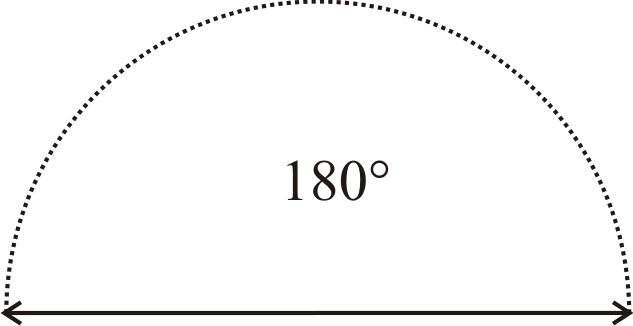
While you are prepping the room, you have to figure out how to work the entire space. I will admit there are some rooms that this becomes impossible and you might have to get creative, however if you spend your entire keynote pointed at one side of the room and the other part gets to look at your back, it will be hard to connect with half of the room. You don't want half the room getting the message and the other half getting a less than subtle non-verbal message.
Watch the crowd
As the crowd is entering, I like to walk around and talk to people, get a sense of what they might be interested in, and adjust the talk accordingly. This is one of the main reasons that I prefer to use my speech as a guide rather than the Ten Commandments, I like the ability to improvise on parts that I think people might be more interested in as the crowds change. Each crowd is different, so each keynote should be as well.
Don't eat
This is the first rule of broadcasting, it should be the first rule of public speaking. If you are at an event that has food, eat before hand. In my case it was a luncheon, so my job is to deliver a talk - not eat chicken salad. I had a big breakfast to take me through and ate lunch at 2:30 after everything was done. Don't eat, it is a mistake that can go wrong in more ways that it will ever be worth.
Answer EVERY question
Yes, even the hard ones. If you are allowing for Q+A and I think you should, I also think you should answer all the questions. The trick here is when your talk is over, stick around because some people don't want to talk in front of people but will ask in a 1-on-1 situation. So, try to stay til everyone leaves so they have a chance to talk to you. That one simple gesture might be the difference in you making a killer connection or even changing someone's life.
I feel it is an honor to be
Now
Ghost pain

Tomorrow I am going to roll out a new talk on social media discussing how a strategy in a combat sport like Brazilian Jiu Jitsu can mirror your strategy in your social media campaigns. Or, to put it a different way, if you don't have a strategy in social media, just like not having one in a fight - you will get your ass kicked.
In the beginning of the talk I am going to show a video of my first no-gi match (think closer to a UFC outfit rather than a more traditional look as in karate) in which I did well early on but as soon as I was tested, I crumpled. In this match the guy I am fighting is supposed to be 145lbs (he isn't) and it appears towards the end of the match he gets me in what is known as a knee bar, except he doesn't.
I tap anyway.

I tapped because instead of training my brain to push through, work through the problem, and advance my position, I allowed my brain to fill in the blanks with ghost pain and assume that my knee going the wrong direction is grounds for quitting - which I did.
As the match ends I roll over and look like I am in a ton of pain, in actuality I am beyond disappointed in myself and learning a lesson in real time. This would be a watershed moment for me where I simply stopped quitting. I stopped quitting in competition, in my relationships, at work, or at play - as soon as it got hard, or I didn't understand, I felt shame, or pain, or whatever, I tried to push through first.
It is the basis of the talk tomorrow because I feel some brands, brand managers, or marketers either don't have a real strategy on a chosen social platform, are trying to execute (terribly) on ALL of the social platforms, or give up when things like Snapchat, Yik Yak, Whisper, Periscope, Meerkat, or Slingshot show up. When the reality of 2015 is this, as marketers, we are living in amazing times where our customers are actually telling us exactly what matters to them, all we have is go to where they actually are and listen.
The days of putting up an open sign in the window and waiting are long over. You need a strategy with a set of goals on a given platform that you can excel at to reach the right customer, with the right message, at the right time, on the right device and that is how you win.
A strategy like that beats any opponent regardless of size. A strategy like that allows you to push through the hard parts and move your brand into a better position so that you can turn that customer from a lead to an advocate, from cold to closed, and your brand from just competing to winning.
Discovering your pain points is an important exercise, you just need to understand which ones actually hurt, work through those, and ignore all the ghost pain - they are distractions that take you and your team away from winning.
The management paradox

When I started managing I had NO idea what I was doing. In fact, I said yes to the job before I even knew what the hell it was. Let me back up, in 2002 the program director before me was let go and five minutes after he was let go the general manager exploded into the studio where I was doing my afternoon show and asked "can you program this radio station, because if you can't we will have to find someone who can."
Turns out that is the most polite to halfway to fire someone, ever.
As would be the case with the rest of my life, I said yes then tried to figure out exactly how I was going to do this. I had been doing the day-to-day stuff for awhile, so I wasn't worried about the "radio" part, it was the people part that terrified me. Most people want to be liked, managers more than most, and in most broadcast mediums that likability runs headlong into ego, some of which is needed and most of which is not. Ego and management tend to get along as well as Michigan and Michigan State fans do, which is to say on a good day - not very well.
So my first few years were brutal, stressful, not fun, yet highly educational. I made my fair share of mistakes and dealt with some issues I never want to encounter again, but I came out on the other side with a view of how I wanted to manage going forward.
1. You don't always need to be right
This is where I struggled the most early on, I thought well, if an employee comes to me with a problem I can't be wrong because that would show weakness. Turns out that is absolute bullshit because nobody can be right all the time, even my wife and she has a killer batting average. So take that feedback and do something meaningful with it, especially if they had the better answer.
2. Care about your team
No not as much as your family, but close. You will spend more time with them and likely deal with more struggle and conflict that empathy can be your greatest asset. Invest in getting to know the people around you and MEAN IT. Don't just ask how their weekend was while you are looking at your phone, be the manager that asks them about their kids playoff soccer game before they tell you about it. Be the type of manager who gets a phone call at 2am and answers it with as much happiness as you can muster up because you know they didn't want to call you just as much as you didn't want to get the call - but you took it anyway because you care about your team.
3. Celebrate the wins.
I am still bad about this but I try, very hard. I have always been a person who ships and moves on so I spend very little time in my personal or professional life celebrating things for myself, there is something else to accomplish. This is a terrible way to live your life.
You have to take time out to celebrate the things your team is doing that are amazing otherwise they will quit doing them, I promise. Hitting goals, having amazing events, or innovating a product line are all things that need to be recognized and celebrated early and often.
4. Get your team where THEY want to be
This is a lesson I learned and embraced while in radio, as a manager it was my job to get the talent to a bigger market or that job they were looking for regardless of what it did to the station at the time and it hurt us bad a couple of times.
The staff were in Grand Rapids to pick up some skills and head off to bigger markets taking their talent and your insight with them. That is the goal. Killer talent wants to continue to get better and sometimes that isn't at their current job. So as a great manager, I feel you have to put your ego aside and get your team to where they are going to be happiest and if that is with you great. But, if it isn't I still think that is your job to help them with gusto then bring in someone new and start the process over.
5. Understand nothing is given, it is all earned
Your team doesn't need to respect you, sorry they don't. You have to earn that and when you do, don't waste it. Because, like time, respect is a commodity in short supply in business that very few people get to enjoy authentically.
6. Never ask something of them you wouldn't do yourself
Yes, there are perks to moving up the corporate ladder but the further you go up the ladder the farther you get away from the action on the ground. So one of the things I always try to do is not ask a member of the team to do anything I am not willing to do myself.
Your team wants their manager to be in the trenches with them not standing on the watchtower yelling down at them. If your team senses that you feel the task is "beneath you" how do you think it makes them feel that you are asking them to do it instead?
7. Leadership isn't a title.
It is an action word, leadership is what you do when your team isn't paying attention (or at least you think they aren't). Leaders do the next right thing every time without excuse and if they stumble they admit it, apologize, and start over. Your title of "manager "doesn't make you a leader, it might make you the guy that approves vacations or time cards, but that job description sounds more like a gig at the DMV than any job I would want to have. Leadership is not just leading by example, it is leading as if it is your singular purpose and sometimes leading means getting out of the way.
You need to know when those times are and then get out of the way and let your team do what you hired them to do.
I have a friend who told me once "everyone wants to be a manager, until they are one." It might be the best description of the job, ever. Leading a team as a manager can be one of the hardest jobs you may ever have, or it can be the most rewarding.
It depends on the way you look at it.
Are you the type of person who wants to see real personal growth in your team and have a part in how that growth is fostered? You will thrive in a management role. But, if you are the type of person who takes that job for the bigger cubicle and better bagels, you and your team are likely in for a bumpy ride.
Trust the process

Writing and presenting have always been a process for me that confuses a lot of people around me. When I present for 10 minutes or 4 hours (in the case of my mass media class) I don't read off of notes, ever. I have spent a long time crafting the ability to use the environment, the slides I choose, and the people in the audience to rebuild the presentation - nearly in real time.
It is important to me that if people have come to hear me, or at least about the ideas, that I am giving them the most up to date and relevant material I can and you can write down every word you want to say and then read it aloud, but if they are the wrong words, or the wrong way to present the topic - you lose the room and waste their time.
Feel free to pick which one of those is worse.
So I thought I would step through my process to do this, and it may not be your thing, but this is what works for me and if you can take anything from it, I am more than happy to share.
Visualization
Before I even start writing (yes, I write it down - I just don't take it with me) I spend a long time visualizing the points I want to make and the places, or concepts that can be the hardest to either present or unpack for people. I tend to stay with those until I understand them enough that my dog Marlowe is tracking along.
Then it is time to write.
Writing
I spend the most time here getting the statistics, research, or points I want to nail down. Since I am only using this as a guide to hit the points I want to hit the words are important and it needs to be in my voice, but it doesn't need to be perfect - yet.
Editing
I have been blessed with an amazing group of 4-5 people I trust to tear my writing a part. If you don't have these people in your life, stop reading and go to craigslist to find them - they are the MOST important part of all of this. I take all of their feedback and re-write til I am confident I was true to their edits while reconstructing 5 different points of view AND keeping the original points I am making in the presentation.
Practice
Once I have the piece where I feel I want it for now, I begin practicing and I do it two or three times focusing on hitting the high points. When I am comfortable I sit down and record an audio version of the talk still using the notes. In this way I use the words I want to use, when I want to use them and then I do one more thing.
Audio Visualization
I am not sure this is actually a word, but it is certainly what I do.
I take that recording and I go for drive after drive in my car listening to my presentation. At the end of each day I do a run-through with no notes (using slides if I am using them) and then do another visual run-through while I drift off to sleep.
After all that, I feel I am ready.
As I said earlier, it might not be a process that works for you but I am finding that I work with more and more people, vendors, partners, employees, and team members who have different processes than I do. Some of their processes I understand, others I do not. But if I have learned one thing through understanding my own process it is that none of the 5 steps above matter if you cannot deliver on the expectation. So as long as they are delivering on expectation the individual processes doesn't matter to me likely shouldn't matter to you.
To adapt a quote from Gary Vaynerchuk here:
"Processes are shit, execution is key."
Moonshot thinking
My sister-in-law is taking a course on innovation and sent this to me after reading my last post:
She sent it because it is incredible, it is moving, and an important lesson we should hang next to our bed, a lesson about following your passion, leaping out of that plane to build the parachute on the way down, all in order to solve problems that we either don't have the solution for, or didn't even know were problems yet.
Videos like this strike me in all of those ways and just one more way that keeps me searching for stuff like this - how did they see it?I ask this question a lot because I find it fascinating to try to get into someone's head and figure out how they view the world. The idea of a radical solution to jump start a breakthrough is something that seems inherent in some and fostered in others but needs to be exercised in everyone order to be good at it.

The thing about training is that it can be hard to do, hard to see immediate results, and not nearly as fun as flying to the moon. But in order to land on the moon, someone had to figure out how to make rocket fuel and that someone could not be told their idea what "stupid" or met with laughter or most certainly they would never speak up in a meeting again.
It becomes vital then to create a process that can foster radical solutions at every organization of every shape and size. How?
Try these three to start.
1. Pick people.
This isn't glib, I mean pick people that will participate in the exercise and not sit on their phone or laptop and count the minutes away while not contributing to the solutions. It is okay not to include people that just aren't ready to change the world.
2. Kill the sacred cows.
If you aren't comfortable with the first step, you HAVE to do this one or you will stall out. Innovation cannot happen if words like "but" or phrases like "the client wants" or "we have always" predicate the excuse why the new idea is a bad one before it has a chance to bloom. Everything has to be open to change or you are going to get a different shade of what you already have which isn't innovation, that's painting the wall of your office.
3. Sit on it.
Set a hard and fast meeting time and walk out when it is over, leaving the opened conversations and more importantly the half-baked
4. Ship it.
Seth Godin nails this one, you have to put some of the ideas out into the world and see what happens. That is how we discover, that is how we test, that is how we learn.
Perhaps it is the video above or the movie version of The Martian, or my second child on the way, but I am overly excited about the idea of doing radical things and seeing what works. I would love to share that excitement with you if you have any moonshots that you want to talk about.
Have a great afternoon.