
BLOG
Empty Apologies
As a dad of a daughter, this has been a pretty amazing week, Ronda Rousey becomes the first female on the cover of the Australian version of Men's Fitness, stopped by Mike and Mike, and co-hosted Sportscenter as the first female athlete to do so.
Also this week Jessica Mendoza became the first female to work as an analyst during baseball's post season. As someone who is constantly looking for role models that I am comfortable pointing my daughter in direction of, this week was uplifting - until we were all graced with Mike Bell's tweets about Jessica Mendoza new job.
The first tweet was a parody of a line from Anchorman:

And as every closed minded misogynistic sports radio anchor does, he goes on.


And on...
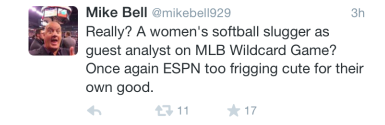
This is not to say that all sports radio hosts feel this way, but I tend to think a lot of them just have better filters. Which honestly better because at least they understand that free speech is not free of consequence and still hold on to their own opinions, no matter how wrong they might be. And as is predictable in the world of instant communication, Mike Bell instantly issued an apology.
“I didn’t get it,” he said. “I get it now. There is no place for that kind of stuff on my show. I will be more mindful. I hope I can be a better talk show host and better person. This has been an eye-opening experience.”
It goes on to explain that he felt that analysts should be professionals or former professionals from said sport, in this case baseball. But let's unpack this for what it is, a chance to keep his job. As of this writing he will be back on the air on Monday so, he got a long weekend to enjoy baseball for his gaff, which is to say it isn't as if he all of a sudden "get's it" and that women should be equal to men because that isn't authentic or even realistic.
Instead, he seems bent that his beloved sports world is moving forward and bringing in a new audience in hopes of increasing attendance which is moving in the wrong direction. TV viewing however is up this year and a great gateway drug to get new fans to enjoy the pennant race on TV and then convert them into buying a ticket where the real money for the franchise is.
Instead, this broadcaster took to twitter (he has deleted his account) to take down a colleague for sport and then apologize afterwards for his awful and unscientific assessment of both fast-pitch softball and women in the role of analysts.

I am amazed that radio still strives to keep people like this, especially when the NFL team your station is the flagship for thinks you should bounce him.

There has been some positive movement in this regard as both CBS and ESPN have started female hosted sports talk shows but, that doesn't even put a dent in the disparity which only points to the importance of this moment. Every word that you say has meaning and if you are a broadcaster or anyone with an audience (which these days is most of us) there needs to be a lens through which you put your comments to determine the effect it might have. Because the wash, rinse, repeat cycle of tweet dumb shit, delete account, and apologize makes the tweet more powerful and the apology, empty.
The cost of FB assimilation
Brands have and continue to have a love/hate relationship with Facebook. After all it is the largest social medium sporting an impressive base of more than 1 billion users accounting for 13% of the TOTAL use of the entire Internet. That alone makes it hard to ignore. However, your brand might be finding it increasingly difficult to get traction on the platform. Posts that at one point used to explode into viral gold now seem like a customer funnel that needs a bit of Drano.
So, what’s the answer? Unfortunately it is simple to start but complicated to finish.
This is a platform that is free and easy to use for the user – not your brand hoping to speak to them. If you are having a problem reaching your customers, you are going to first need to build spend into your existing campaigns for Facebook posts. The good news here is that Facebook ads have some of the best cost per acquisition of any platform and the targeting (that is coming soon to Instagram) is unparalleled.
The second thing for your brand to check is that you actually have a strategy to not only get the content OUT to your customer but a strategy to CREATE that content first. In the marketing world the adage “content is king, context is god” is never more truthful than it is on Facebook. In order to connect you are going to have to create content and value. The age of the curator is alive and well, but if you are a brand that is merely a curator, your customer is going to figure out your source and cut out the middleman, which is you.
Instead, opt for creating things that are of tremendous value to your customer. What can you give to the customer that is both on-brand and of value to them? Once you are of the mindset that creating is a better play that curating it is time to create that strategy.
How many times per day?
There is no doubt that this will be, and likely should be, your first question. How you answer it depends on your team and trust. Why trust? Because you are going to have to fall on your face and make some mistakes in order to figure out your cadence on Facebook. It will be more than what you need for LinkedIn, but not anything like what you might need to succeed on Twitter.
As a baseline I tend to start with three posts and work from there. Try once in the morning and then again in the afternoon and finally once in the evening (research shows that 1 and 3pm are empirically good times for posts to get liked or shared). But a word of caution as this is where the failing comes in; you need to figure out when YOUR customer wants content. I typically look to post sometime after 7pm for my final push when people are winding down and looking for, you guessed it, content.
Once you have the times in place run with them for a month and then take a look at what you have and measure it against what you are trying to accomplish on Facebook. Do you want more likes? Clicks to your website? More comments and shares? Adjust your pace and your content to meet the goal you are trying to achieve.
Becoming a practitioner, like anything that is new, can be hard at first but if you have a plan and have the wherewithal to ditch that plan when it isn’t working you have the opportunity to win big on Facebook. As with everything you have to show up and get your hands dirty first in order to enjoy the fruits of your labor.
Taylor Swift's favorite thing was Ryan Adams yesterday, today it is this
It is sort of amazing.
Do I NEED to be on Twitter?

This is a very common question that has an interesting answer, which is no. I say no because unless your brand has content that falls into a breaking news or live event space, the Twitter ecosystem can be very daunting to break through on. Twitter is a platform that has had some of the least innovation since launch and as a platform is a fire hose of content blasting at the user at a rate of over 500 million tweets per day. To add context, if this were email you would be getting an email from nearly 20% of the people in the United States, every, single, day.
So how does a brand excel at Twitter?
By connecting.
This is the other thing that brands find discouraging because Twitter is not a place where you should push out content all day. Where Twitter is brilliant is that it is still the place where people come to talk about what is going on RIGHT NOW. So, as a brand, we need to leap into these conversations where it makes sense and interact with our customers, because that is what they have come to expect. Customers are looking to brands on social that understand the language of the medium they are using and in turn reward those that engage with them with their time and interest. If you are a brand that is very adept at this, you can turn that time and interest into advocacy and look to those brand advocates to help scale your story.
The trick with Twitter isn’t so much the 140 characters; it is trying to scale 1-on-1 conversations. Brands that have the ability to talk to customers as if they were the only person in the room have an unfair advantage on a platform like Twitter. If you are looking for some great examples, check out @Tacobell and @therealPSL. Both accounts (while both in the QSR space) do a tremendous job at speaking to the customer instead of at them. In fact in 2014 the Starbucks account @TheRealPSL was attributed to a 21% increase in sales of the Pumpkin Spice Latte and of the 10,000 tweets that account sent that year nearly 70% of them were mentions of customers and not brand messaging.
The ability to scale 1-to-1 is how you win on Twitter.